
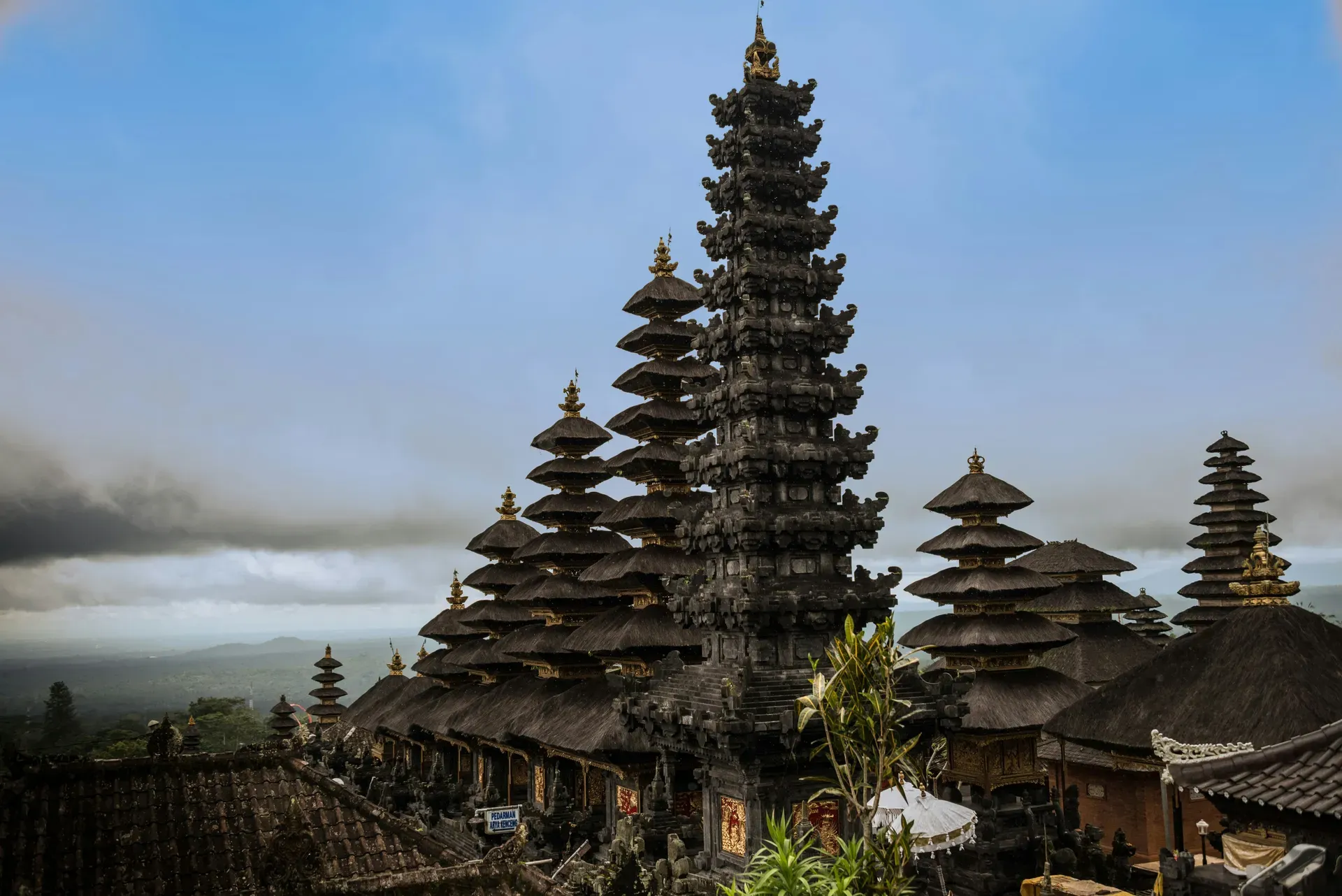
Besakih Temple spans six terraced levels on the southwestern slopes of Mount Agung, 1,000 meters above sea level. This 23-temple complex is the spiritual center of Balinese Hinduism and the only site where all castes worship together.
Eighty-six individual shrines spread across a three-kilometer stretch of volcanic slope. Besakih Temple occupies the southwestern face of Mount Agung, 1,000 meters above sea level. Twenty-three distinct but related temples make up this complex, connected by steep stone staircases and split gateways. The site functions as the spiritual center of Balinese Hinduism. Devotees from across the island travel here to pray, making it the only sanctuary where people of all castes worship side by side.
Clouds often roll in by mid-morning, obscuring the 3,142-meter peak of the active volcano behind the multi-tiered thatched roofs. The air at this altitude feels noticeably cooler than the coastal hubs of Kuta or Seminyak 60 kilometers away. Visitors walk up hundreds of ancient, uneven stone steps to navigate the six terraced levels. Rain turns these moss-covered paths slick. Driving from Ubud takes 90 minutes and covers 40 kilometers of winding roads. The journey from Kuta or Seminyak requires at least two and a half hours due to heavy traffic in the southern hubs.
The 150,000 IDR entry ticket includes a five-minute electric shuttle ride from the parking terminal to the main entrance. A local guide is also provided to navigate the sprawling layout and prevent tourists from accidentally entering the inner sanctums. The entry fee covers the rental of a traditional sarong and waist sash, both mandatory for all visitors regardless of gender. Shoulders must remain covered. Women on their menstrual cycle and individuals with open wounds cannot enter the grounds due to strict local customs regarding ritual purity.
Arrive before 09:00 to beat the large tour buses and secure clear views of the mountain backdrop. The complex opens at 07:00 daily. Visitors spend an average of two hours exploring the outer courtyards. Aggressive vendors frequently approach tourists near the entrance gates selling flowers and offerings. A firm refusal is necessary if you do not intend to purchase these items. The dry season from April to October provides the safest walking conditions. Heavy downpours between November and March flood the lower steps and create severe slip hazards. Always check the official volcanic alert level before driving up the mountain, as Mount Agung remains highly active. Keep your physical ticket visible to access the shuttle and prove you have paid the official guide fee.
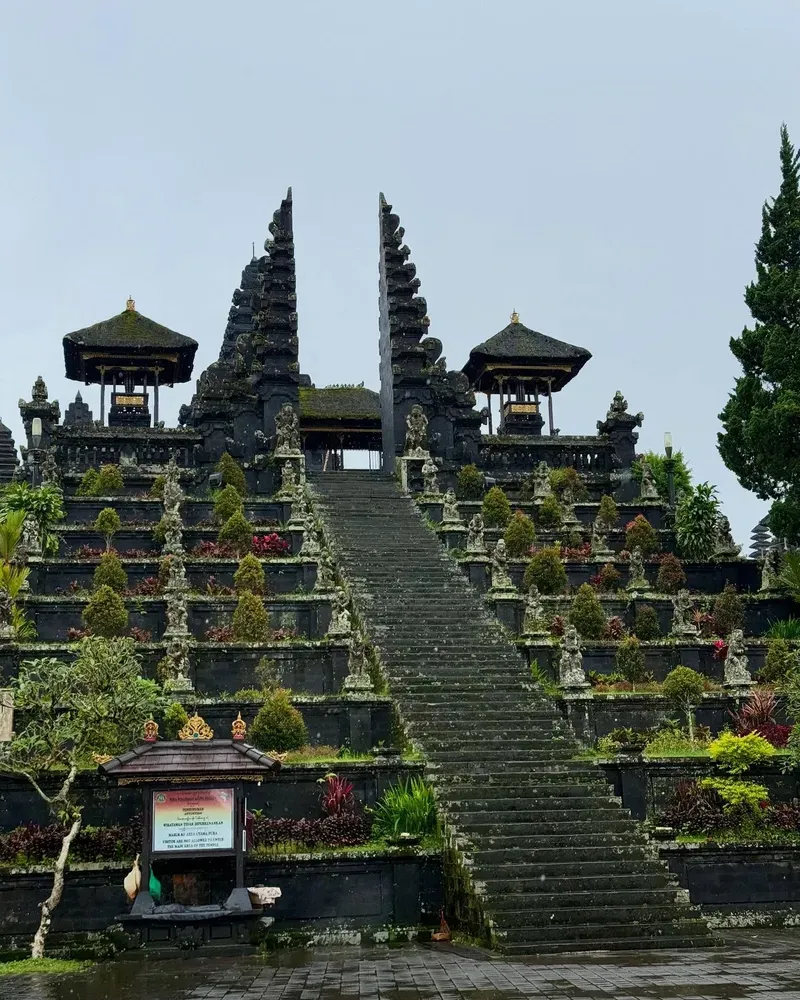
Megalithic stepped pyramids form the foundation of Besakih, indicating prehistoric use of this volcanic slope long before Hinduism reached Bali. The first written record of the site appears in a stone inscription dating to 1007 AD. Rsi Markandeya, an Indian sage, led a major expansion in 1284. He established the foundational layout that dictates the complex's current orientation toward Mount Agung.
The Gelgel dynasty claimed Besakih as their state temple during the 15th century. King Dalem Waturenggong ruled during this golden age, expanding the empire's influence to neighboring islands. This royal patronage funded the construction of numerous shrines and established the site's supreme status among Bali's directional temples. Successive kings added their own pavilions and Meru towers, expanding the sanctuary across six distinct terraced levels. Each ruling family built specific shrines to honor their ancestors, resulting in the dense concentration of 86 individual structures seen today.
Mount Agung erupted violently in 1963, killing nearly 2,000 people and devastating the surrounding villages. The eruption began on February 18 and peaked on March 17. Ash columns reached 20 kilometers into the atmosphere. Lava flows tore down the mountain but stopped exactly 15 meters from the outermost walls of Pura Penataran Agung. Balinese Hindus interpreted this near-miss as a divine signal, reinforcing the belief that the gods were demonstrating their power while protecting their earthly residence. The ash from the eruption coated the thatched roofs for months, requiring a massive community effort to clean and restore the complex.
The Indonesian government nominated the complex for UNESCO World Heritage status in 1995. The submission highlights the site's unique blend of megalithic and Hindu architectural styles. It remains on the tentative list today. Modern infrastructure updates include an electric shuttle system and paved access roads to accommodate the thousands of daily visitors. Heavy rains between November and March frequently cause minor landslides along these access routes, requiring constant maintenance by local authorities.
In recent decades, the provincial government standardized the ticketing system to combat illegal guide scams. Touts previously blocked the entrance, demanding exorbitant fees from foreign tourists. The current 150,000 IDR ticket centralizes these costs, though unauthorized individuals still occasionally operate near the outer parking lots. Ignore anyone claiming the main gates are closed for a private ceremony.
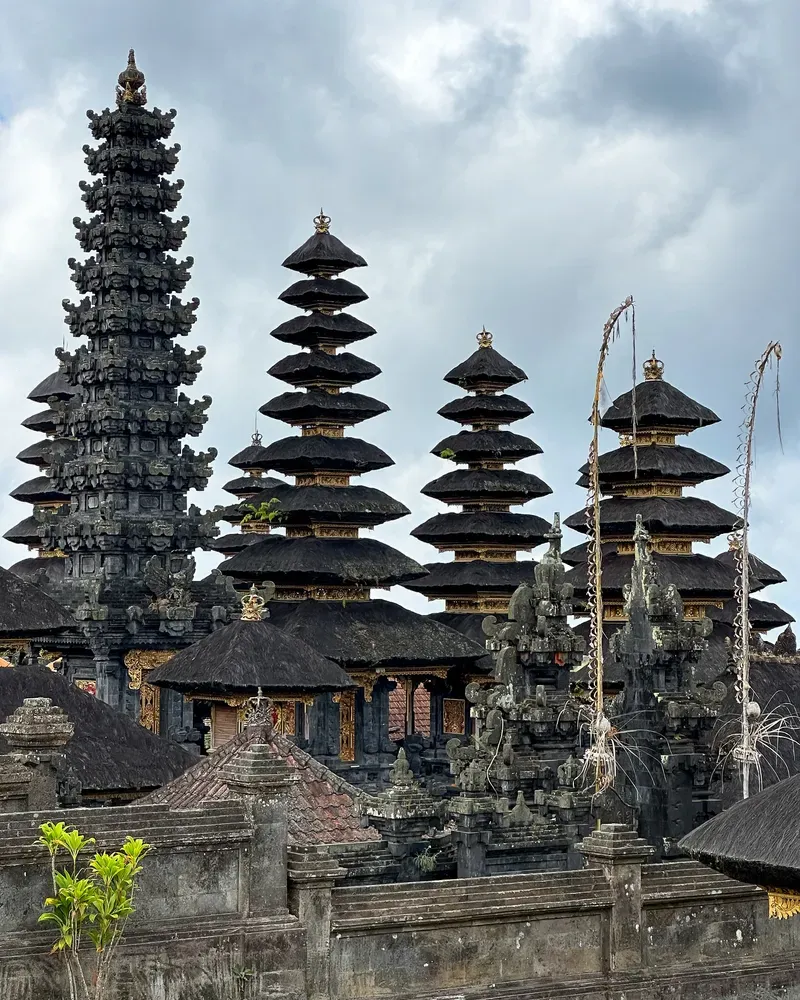
Six terraced levels follow the natural incline of Mount Agung. Pura Penataran Agung anchors the complex as the largest and most central structure. A massive stone staircase consists of 52 individual steps leading to its iconic Candi Bentar. This split gateway measures precisely 15 meters tall, constructed entirely without mortar. The two halves mirror each other perfectly, framing the mountain peak on clear days. Inside this primary courtyard, 22 individual temples dedicated to Shiva surround the main prayer areas. The layout forces visitors to climb continuously, representing a physical ascent toward the divine.
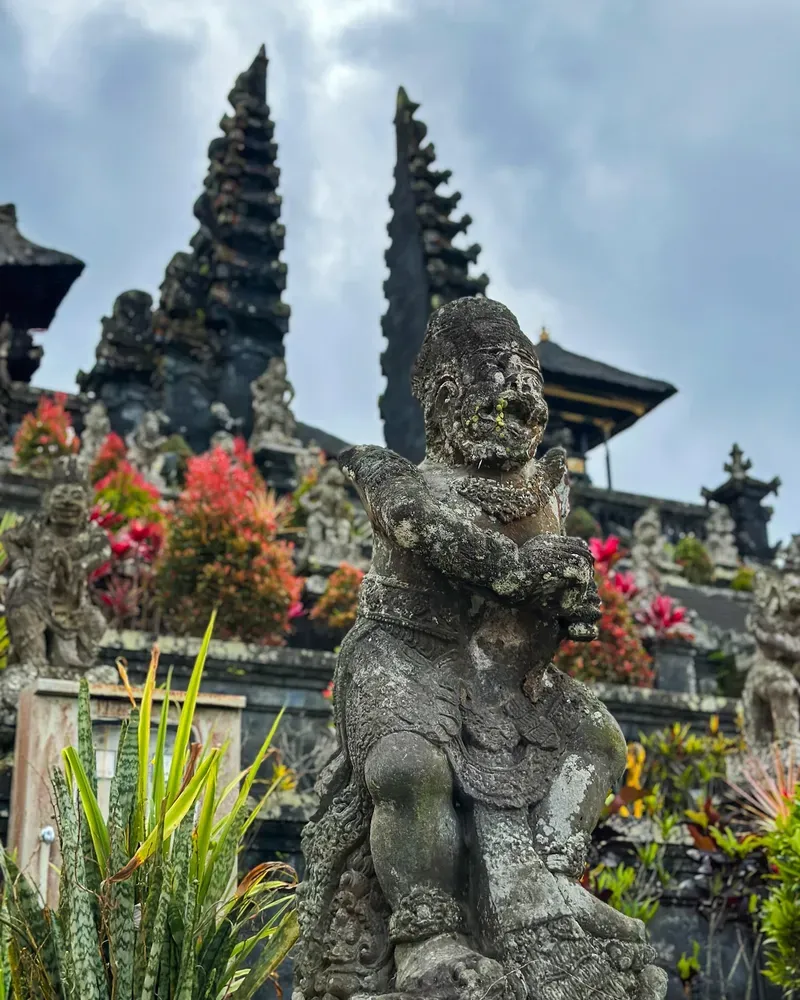
Black palm fiber thatch covers the roofs of the Meru towers. These wooden pagodas vary in height, with the most sacred structures reaching 11 tiers. The 11-tiered towers represent the highest level of divinity, specifically honoring Shiva. Lower towers with three, five, or seven tiers honor lesser deities and ancestors. Artisans carve the supporting pillars from jackfruit wood, leaving the natural grain exposed to the mountain air. Volcanic rock forms the foundation and walls of every shrine, giving the entire complex a dark, porous texture that absorbs the frequent mist. Gold leaf accents decorate the wooden doors of the inner sanctums, providing a sharp contrast against the black stone.
Pura Pangubengan sits at the highest elevation, requiring a 30-minute uphill walk from the central courtyard. This secluded northern temple offers an unobstructed vantage point over the lower terraces and the distant southern coastline. The stone steps leading here lack handrails. Damp conditions make the descent treacherous, forcing visitors to step sideways to maintain their footing.
The architectural design strictly follows the Tri Hita Karana philosophy, dividing the space into three zones. The Nista Mandala serves as the outer transition area. The Madya Mandala functions as the middle courtyard for preparation. The Utama Mandala acts as the holiest inner sanctum. Tourists are restricted to the first two zones. Low brick walls separate these areas, topped with carved stone demons meant to frighten away malevolent spirits. Red hibiscus flowers frequently adorn these statues, placed there daily by the temple priests.
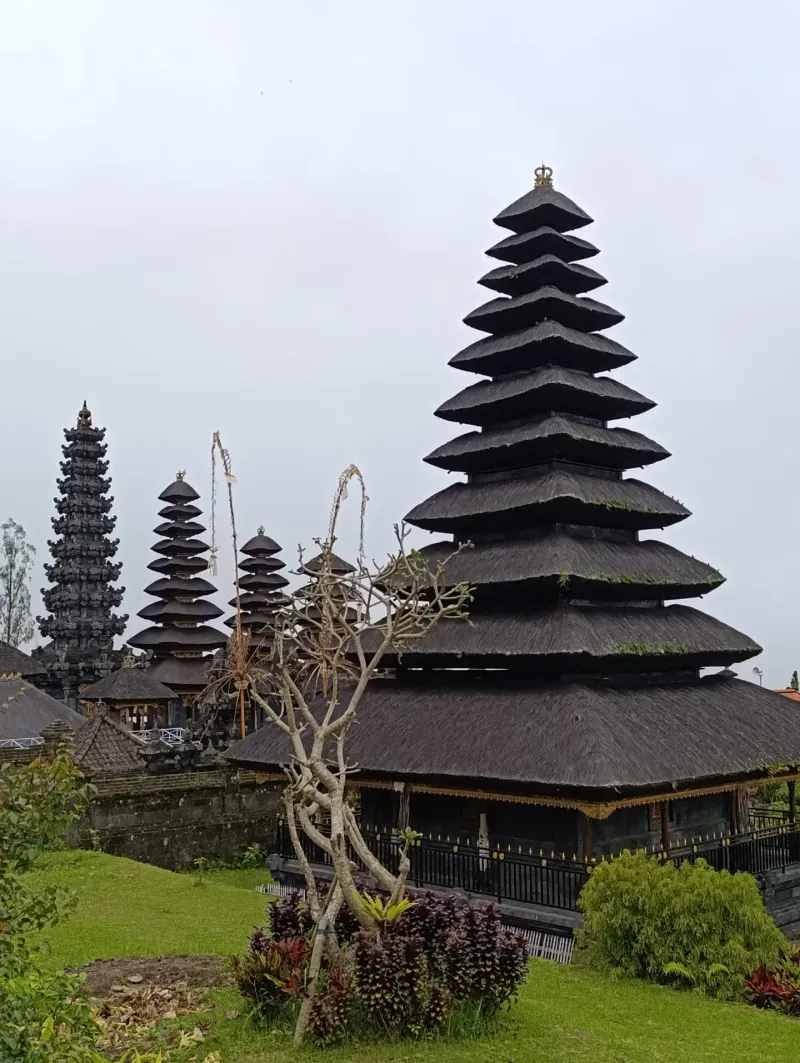
Balinese Hinduism relies on a network of directional temples, known as Kahyangan Jagat, to protect the island from evil spirits. Besakih occupies the most critical position in this spiritual grid. It anchors the northeast, the direction of the sacred mountain. It represents the center of the universe in local cosmology. Every regency in Bali maintains its own specific shrine within the complex, ensuring physical representation for the entire island's population.
Social hierarchies dissolve at the main gates. This is the only religious site in Bali where members of the Sudra, Wesia, Satria, and Brahmana castes pray in the same courtyard. During the annual Bhatara Turun Kabeh festival in March or April, devotees believe all deities descend from the mountain to reside in the shrines for a full month. The timing aligns with the tenth full moon of the Balinese calendar. Thousands of worshippers carry towering fruit offerings up the steep stairs during this period. Women balance 'gebogan'—cylindrical offerings of fruit and cakes reaching up to two meters high—on their heads while climbing the 52 main steps.
Gamelan orchestras play continuously in the outer pavilions, their metallic percussion echoing off the stone walls. Tourists cannot enter the Utama Mandala at any time. These areas remain strictly reserved for active worship, marked by low wooden gates and warning signs in multiple languages. Priests dress entirely in white, sprinkling holy water on the crowds gathered on the stone floors. They source this holy water, or 'tirta', from a sacred spring located deep within the bamboo forest above Pura Pangubengan.
The scent of burning sandalwood incense permeates the humid air. Families often travel for hours in open-backed trucks to reach the mountain, bringing woven palm-leaf baskets filled with rice, flowers, and coins. The physical exertion required to reach the upper shrines is considered part of the spiritual purification process. Do not point your feet toward the shrines if you sit down to rest, as this is highly offensive in Balinese culture.
During the 1963 Mount Agung eruption, lava flows stopped exactly 15 meters away from the main temple walls.
Archaeologists found stepped megalithic pyramids beneath the Hindu shrines, proving the site predates modern religion.
The tallest Meru pagodas have exactly 11 thatched roofs, the maximum number permitted in Balinese architecture.
Besakih is the only temple in Bali where all four Hindu castes are allowed to worship together in the same courtyard.
The complex is not a single building, but a network of 23 distinct temples spread over three kilometers.
The annual Bhatara Turun Kabeh festival lasts 30 days, drawing thousands of daily pilgrims carrying massive fruit offerings.
Local custom dictates that individuals with open wounds or women on their menstrual cycle are legally barred from entering.
Besakih Temple is the largest Hindu sanctuary in Bali, consisting of 23 separate temples. It sits 1,000 meters above sea level on the southwestern slopes of Mount Agung.
The international entrance fee is 150,000 IDR. This price includes a sarong rental, a local guide, and a one-way electric shuttle ride from the parking area.
No. Tourists must remain in the outer courtyards. The inner sanctums are strictly reserved for Hindu worshippers.
A local guide is included in your ticket price and is required to navigate the complex. They ensure visitors do not accidentally enter restricted prayer areas.
All visitors must wear a sarong and a waist sash. Shoulders must also be covered at all times.
No. The complex features hundreds of steep stone steps and uneven volcanic terrain. Recently installed ramps are too steep for safe wheelchair use.
Drone flights are strictly prohibited within the temple grounds. Commercial filming requires a specific permit from the Karangasem Regency office.
A typical visit lasts about two hours. Climbing to the highest temple, Pura Pangubengan, adds another 30 minutes of uphill walking.
Balinese Hindu custom prohibits women who are menstruating and anyone with an open wound from entering the temple grounds.
Arrive between 07:00 and 09:00. This avoids the midday heat, large tour bus crowds, and the clouds that usually obscure Mount Agung by late morning.
Browse verified tours with free cancellation and instant confirmation.
Find Tours